
Abstract
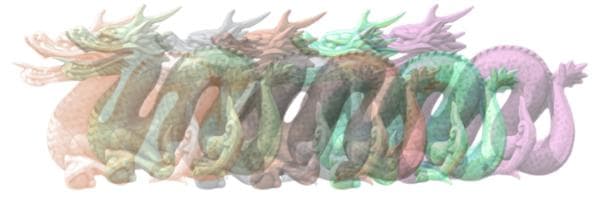
Order independent transparency (OIT) is a technique in computer graphics that allows for accurate rendering of transparent objects without the need to sort them in a specific order based on their depth. Traditional transparency methods often suffer from artifacts and inaccuracies due to this sorting process, especially in complex scenes with many overlapping transparent surfaces. OIT is important because it provides a more visually correct representation of transparent materials, ensuring that colors mix accurately and that all elements are rendered consistently, regardless of their draw order. This enhances realism in applications such as video games, simulations, and visual effects in films. The tutorial will provide an overview of traditional (exact, approximate and hybrid) and deep learning approaches to OIT and examine their scope, performance and accuracy.
BibTeX Citation
@inproceedings{Tsopouridis2025,
booktitle = {Eurographics 2025 - Tutorials},
editor = {Mantiuk, Rafal and Hildebrandt, Klaus},
title = {{Traditional and Neural Order-Independent Transparency}},
author = {Tsopouridis, Grigoris and Georgiou-Mousses, Christos and Fudos, Ioannis and Corrigan, David and Franke, Tobias Alexander},
year = {2025},
publisher = {The Eurographics Association},
ISSN = {1017-4656},
ISBN = {978-3-03868-267-7},
DOI = {10.2312/egt.20251001}
}