
Abstract
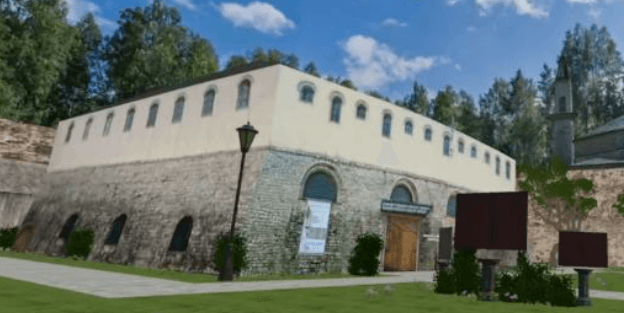
Recent advancements in computer science, particularly in computer graphics and computer-aided design (CAD), play a crucial role in preserving cultural heritage. Technologies such as virtual and augmented reality allow users to explore cultural and historical settings, providing immersive experiences of reimagined events and figures from the past, which foster valuable learning opportunities. Furthermore, 3D modeling and reconstruction are essential tools for documenting and restoring significant cultural artifacts. In this paper, we present an immersive exploration of the cultural heritage and contemporary history of the Epirus region in Greece using virtual reality and 3D reconstruction. This project utilizes materials and artifacts collected at the Historical Archives and Museum of Epirus, alongside historical documents preserved by the institution. We specifically employed photogrammetry and 3D scan-ning techniques to reconstruct models of objects displayed in the museum, categorized under various themes, including athleticism, agriculture, art, and everyday life. These 3D models were integrated into virtual reality scenarios that reflect the region's contemporary history, vividly bringing the narratives of Epirus to life.
BibTeX Citation
@InProceedings{10.1007/978-3-032-15069-1_9,
author="Fudos, Ioannis
and Koutsikou, Stavroula-Dimitra
and Kyriazis, Ioannis
and Stamati, Vasiliki
and Papadopoulou, Martha",
editor="Moropoulou, Antonia
and Georgopoulos, Andreas
and Ioannides, Marinos
and Doulamis, Anastasios
and Lampropoulos, Kyriakos
and Ronchi, Alfredo",
title="Exploring the Contemporary History of Epirus Through an Immersive Virtual Reality Experience",
booktitle="Transdisciplinary Multispectral Modeling and Cooperation for the Preservation of Cultural Heritage",
year="2026",
publisher="Springer Nature Switzerland",
address="Cham",
pages="106--123",
abstract="Recent advancements in computer science, particularly in computer graphics and computer-aided design (CAD), play a crucial role in preserving cultural heritage. Technologies such as virtual and augmented reality allow users to explore cultural and historical settings, providing immersive experiences of reimagined events and figures from the past, which foster valuable learning opportunities. Furthermore, 3D modeling and reconstruction are essential tools for documenting and restoring significant cultural artifacts. In this paper, we present an immersive exploration of the cultural heritage and contemporary history of the Epirus region in Greece using virtual reality and 3D reconstruction. This project utilizes materials and artifacts collected at the Historical Archives and Museum of Epirus, alongside historical documents preserved by the institution. We specifically employed photogrammetry and 3D scanning techniques to reconstruct models of objects displayed in the museum, categorized under various themes, including athleticism, agriculture, art, and everyday life. These 3D models were integrated into virtual reality scenarios that reflect the region's contemporary history, vividly bringing the narratives of Epirus to life.",
isbn="978-3-032-15069-1"
}