
Abstract
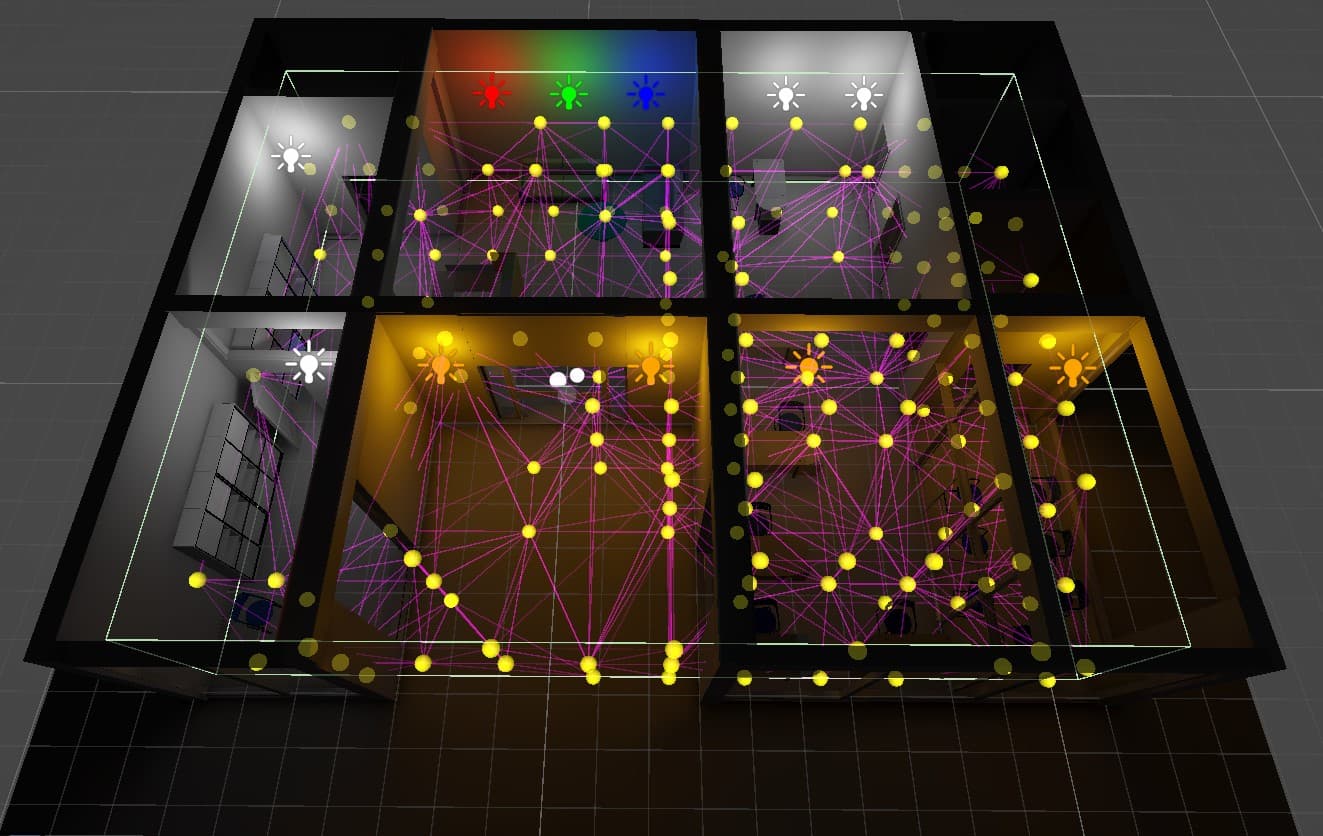
This work proposes an automated learning-based strategy for computing light probe layouts efficiently under varied illumination conditions. A neural network model estimates the relative contribution of candidate probes, enabling the rapid construction of a compact configuration that maintains the scene’s indirect lighting distribution. Evaluations on complex environments indicate that the method achieves substantial speedups over conventional placement methods without compromising illumination fidelity.
BibTeX Citation
@article{tarasidis_2026,
    booktitle = {Eurographics 2026 - Posters},
    editor = {Gerrits, T. and Teschner M.},
    title = {Deep Illumination–Guided Light Probe Placement}},
    author = {Tarasidis, Andreas and Vasilakis, Andreas A. and Fudos, Ioannis},
    year = {2026},
    publisher = {The Eurographics Association}
}