
Abstract
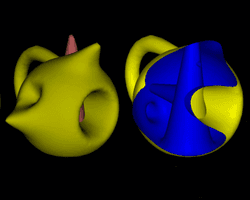
We explore different semantics for the solid defined by a self-crossing surface (immersed sub-manifold). Specifically, we introduce rules for the interior/exterior classification of the connected components of the complement of a self-crossing surface produced through a continuous deformation process of an initial embedded manifold. We propose efficient GPU algorithms for rendering the boundary of the regularized union of the interior components, which is a subset of the initial surface and is called the trimmed boundary or simply the trim. This classification and rendering process is accomplished in realtime through a rasterization process without computing any self-intersection curve, and hence is suited to support animations of self-crossing surfaces. The solid bounded by the trim can be combined with other solids and with half-spaces using Boolean operations and hence may be capped (trimmed by a half-space) or used as a primitive in direct CSG rendering. Being able to render the trim in realtime makes it possible to adapt the tessellation of the trim in realtime by using view-dependent levels-of-details or adaptive subdivision.
BibTeX Citation
@article{journals/cad/RossignacFV13,
author = {Jarek Rossignac and
Ioannis Fudos and
Andreas Vasilakis},
title = {Direct rendering of Boolean combinations of self-trimmed surfaces},
journal = {Computer-Aided Design},
volume = {45},
number = {2},
year = {2013},
pages = {288-300},
ee = {http://dx.doi.org/10.1016/j.cad.2012.10.012}
}