
Abstract
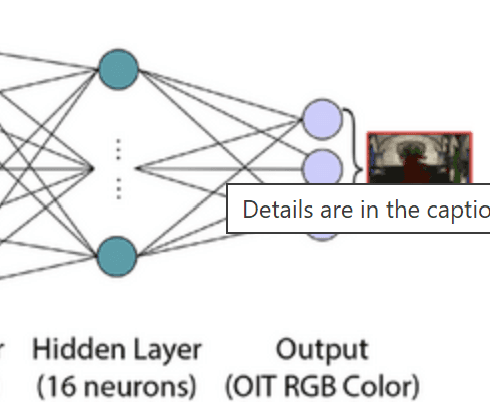
We present a machine learning approach for efficiently computing order independent transparency (OIT) by deploying a light weight neural network implemented fully on shaders. Our method is fast, requires a small constant amount of memory (depends only on the screen resolution and not on the number of triangles or transparent layers), is more accurate as compared to previous approximate methods, works for every scene without setup and is portable to all platforms running even with commodity GPUs. Our method requires a rendering pass to extract all features that are subsequently used to predict the overall OIT pixel colour with a pre-trained neural network. We provide a comparative experimental evaluation and shader source code of all methods for reproduction of the experiments.
BibTeX Citation
@article{https://doi.org/10.1111/cgf.15071,
author = {Tsopouridis, Grigoris and Vasilakis, Andreas A. and Fudos, Ioannis},
title = {Deep and Fast Approximate Order Independent Transparency},
journal = {Computer Graphics Forum},
volume = {43},
number = {6},
pages = {e15071},
keywords = {rendering, visibility determination, order-independent transparency, real-time rendering, deep learning},
doi = {https://doi.org/10.1111/cgf.15071},
url = {https://onlinelibrary.wiley.com/doi/abs/10.1111/cgf.15071},
eprint = {https://onlinelibrary.wiley.com/doi/pdf/10.1111/cgf.15071},
abstract = {Abstract We present a machine learning approach for efficiently computing order independent transparency (OIT) by deploying a light weight neural network implemented fully on shaders. Our method is fast, requires a small constant amount of memory (depends only on the screen resolution and not on the number of triangles or transparent layers), is more accurate as compared to previous approximate methods, works for every scene without setup and is portable to all platforms running even with commodity GPUs. Our method requires a rendering pass to extract all features that are subsequently used to predict the overall OIT pixel colour with a pre-trained neural network. We provide a comparative experimental evaluation and shader source code of all methods for reproduction of the experiments.},
year = {2024}
}