
Abstract
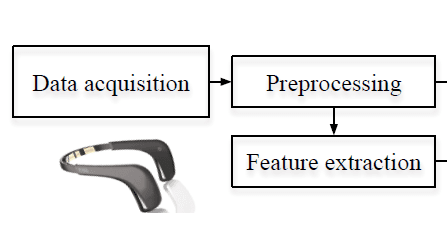
We report on the development of a cutting-edge brain-computer interface (BCI) network that leverages the sensor output of a low cost electroencephalogram (EEG) headband to detect specific eye and head movements, enabling intelligent wheelchair navigation. Using a hybrid CNN-LSTM architecture, our method achieves high accuracy classification of these movements while maintaining low inference time on the complete EEG signal. To validate our approach, we conducted a comprehensive experimental evaluation
BibTeX Citation
@inproceedings{10.1145/3625007.3627480,
author = {Amvazas, Nick and Moschopoulos, Spyridon and Koritsoglou, Kyriakos and Tatsis, Giorgos and Fudos, Ioannis and Tzovaras, Dimitrios},
title = {Introducing a high-accuracy brain-computer interface (BCI) for intelligent wheelchairs},
year = {2024},
isbn = {9798400704093},
publisher = {Association for Computing Machinery},
address = {New York, NY, USA},
url = {https://doi.org/10.1145/3625007.3627480},
doi = {10.1145/3625007.3627480},
abstract = {We report on the development of a cutting-edge brain-computer interface (BCI) network that leverages the sensor output of a low cost electroencephalogram (EEG) headband to detect specific eye and head movements, enabling intelligent wheelchair navigation. Using a hybrid CNN-LSTM architecture, our method achieves high accuracy classification of these movements while maintaining low inference time on the complete EEG signal. To validate our approach, we conducted a comprehensive experimental evaluation.},
booktitle = {Proceedings of the 2023 IEEE/ACM International Conference on Advances in Social Networks Analysis and Mining},
pages = {583–587},
numpages = {5},
keywords = {brain computer interface, deep learning, wheelchair navigation, EEG},
location = {Kusadasi, Turkiye},
series = {ASONAM '23}
}